316 / 316L Stainless Steel CNC Machining
CNC machining of 316 and 316L stainless steel: collected property envelope with heat-treatment condition, marine and chemical-service selection points, and quotation inputs.
Last updated: 2026-10-31
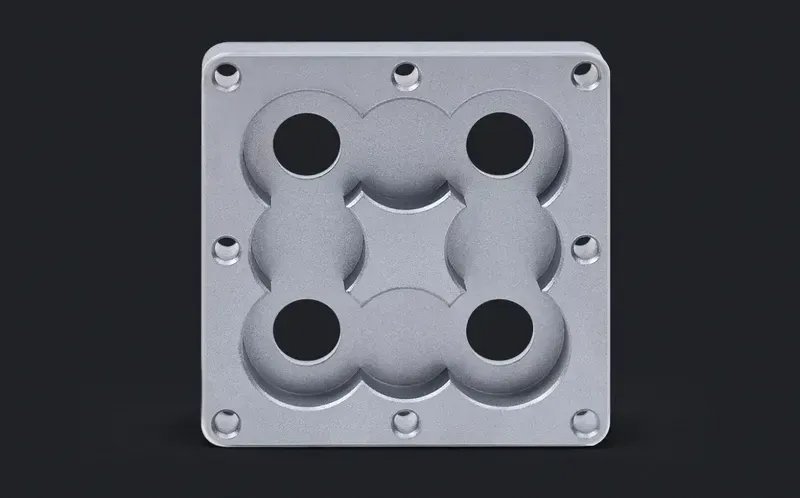
316 is the molybdenum-bearing austenitic stainless steel specified wherever chlorides are part of the environment: marine hardware, coastal installations, chemical and pharmaceutical process equipment, and medical devices that see repeated sterilization. The low-carbon 316L variant is the same family with welding in mind — it resists sensitization at weld zones, which is why fabricated assemblies usually specify it.
As a machining material, 316 behaves like its austenitic sibling: tough, gummy, work-hardening, and demanding sharp tooling with steady feeds. Its corrosion advantage is entirely environmental, not mechanical — for strength-limited designs the austenitic family is the wrong place to look, because heat treatment does not raise its strength. That distinction decides more grade disputes than any property table.
Specifications
| Property | Value | Condition |
|---|---|---|
| Tensile strength | ≥485 MPa (316/316L); 316 ≈570 MPa | annealed |
| Yield strength (0.2% offset) | 316 ≈290 MPa; 316L ≈170 MPa (0.2% offset) | annealed |
| Elongation | ≥40% | annealed |
| Hardness | 160–201 HB | annealed |
Values above are rendered from the collected model-evidence layer, each carrying the heat-treatment condition it was reported under; fields without collected evidence are stated as not established rather than estimated. Requirements outside the table are confirmed for the specific geometry and batch at quotation.
Applications & Selection Points
Marine, coastal and chloride service
This is the grade’s reason to exist. Splash-zone hardware, boat fittings, plant located near de-iced roads, and brine-handling equipment all pit ordinary austenitic grades where 316 resists. If the part lives outdoors within reach of salt spray, the molybdenum premium is usually cheaper than one warranty cycle. State the exposure on the RFQ so the grade decision is made on evidence.
Chemical, pharmaceutical and sanitary equipment
Process lines that see chlorinated cleaners, acids in moderate concentration, or require validated cleanability specify this family for both resistance and surface quality. Machined valve bodies, fittings and clamp connections are typical. Sanitary surfaces add a polishing and passivation requirement — carry it through to the finish callout so it is quoted, not discovered.
Medical and food-contact components
Instruments and device hardware that survive autoclave cycles are a natural fit, with the caveat that implant-grade applications have their own material standards — confirm which specification the part must cite. Repeated sterilization, not just corrosion, is the selection driver here, and the low-carbon variant is preferred where the component is welded before final machining.
Where the family is the wrong call
Strength-critical machined parts — heavily loaded shafts, actuator components, fasteners under high preload — exhaust austenitic grades quickly, because cold work is their only strengthening route and machining relieves it. High-strength stainless service belongs to the precipitation-hardening family, at the cost of some corrosion resistance. Cavitating or abrasive service also wears this family fast despite its chemical inertness.
Machining 316: what the molybdenum addition changes at the cutter
The same toughness and work-hardening tendency that define the austenitic family are slightly worse here: the alloying that buys corrosion resistance also makes the chip tougher and hotter, so tool life on 316 runs shorter than on 304 for identical geometry. The process answers are the family ones, applied more firmly — sharp positive-rake edges, steady feeds with no dwelling, flood coolant as a default rather than an option, and chip evacuation treated as a design input on deep features. Shops that quote both grades side by side typically show the difference in cycle time and tooling, not in feasibility.
Tolerance and surface finish on a gummy austenitic
General-feature tolerances are routine; the risk concentrates where a fine surface finish meets a work-hardening material. Finishing passes that rub instead of cut leave hardened smear that polish operations then struggle to remove, so the reliable route to a fine callout is a genuinely cutting finish pass followed by polishing or lapping as planned secondaries. Sanitary-polish callouts should state the grit or roughness expectation explicitly — "polished" alone is interpreted differently by every shop in the chain.
Failure and nonconformance modes specific to 316 parts
Beyond the family-wide defects (built-up edge, work-hardened glazing, chip re-cutting), 316 parts see three characteristic problems: pitting that traces to environment beyond the grade’s chloride rating — crevices under gaskets and deposits are where it starts, not open surfaces; sensitization at weld zones on parts fabricated from standard-carbon stock instead of the L variant; and stress-corrosion cracking in hot chloride service, which no austenitic grade fully escapes. None of these are machining defects, which is exactly why the service environment belongs on the RFQ — it converts a field failure into a grade decision made in advance.
Machinability positioning and substitution pressure
Buyers under cost pressure tend to probe two directions: back to 304 when the chloride case is weak, and forward to free-machining variants when volume is high. Both are legitimate if the environment and the specification allow, and both should be resolved at quotation rather than by silent substitution — a substitution made without agreement is a nonconformance even when the part measures fine. Custom or off-standard grades are the third direction, and the linked knowledge article walks when substituting is defensible.
Frequently Asked Questions
What is the difference between 316 and 316L?
Carbon content: the L variant carries less, which is what resists sensitization — chromium-carbide precipitation at weld zones that locally robs corrosion resistance. Choose 316L for anything welded; either is fine for fully machined, unwelded parts unless the drawing cites a specific standard. Mechanical minimums differ slightly between the variants, so the cited specification should match the variant actually supplied.
Do I really need 316, or will 304 do?
Map the environment, not the budget. Ambient indoor and washdown service rarely justifies the molybdenum premium; chloride exposure — marine, coastal, de-icing salt, chlorinated process fluids — usually does. The comparison article linked below walks the decision with the property envelope side by side. When the environment is genuinely borderline, quote both: the price delta is often smaller than expected.
What should I send for a 316 machining quote?
The standard package — model, drawing with tolerances, named grade and variant, quantity, finish — plus two inputs specific to this family: the service environment (it validates the grade choice) and whether the part is welded in your assembly, which decides the L variant and any post-weld treatment. Passivation and surface-finish requirements should be callouts, not verbal agreements.
Does 316 machine much differently from 304?
It machines like 304 with the difficulty turned up slightly: tougher chips, more heat at the edge, somewhat shorter tool life on the same geometry. Nothing about a 316 part is unmanufacturable for that reason, but cycle time and tooling cost sit a step above its sibling, and features that already stress 304 — deep small bores, thin walls, fine cosmetic finishes — are where the difference concentrates. The practical consequence for procurement is to leave machining headroom in the schedule when a design wavers between the two grades late.
Can 316 parts be made stronger with heat treatment?
No — the austenitic family does not respond to hardening heat treatment; its strength comes from composition and cold work, and machining removes most cold work. If a design needs both corrosion resistance in chloride service and substantially higher strength, the honest routing is a precipitation-hardening grade or a duplex family member, evaluated for the specific environment. Specifying 316 and adding a strength note on the drawing does not create the strength; it only moves the discovery to first-article inspection.
Ordering & Documentation
Documents
STEP model plus 2D drawing with tolerances and threads; name the exact designation — 316 or 316L, and the product standard if the part must cite one. Welded-in-assembly is a document-level fact: it changes the variant, the post-weld plan and sometimes the machining sequence.
Quotation
Priced from model and drawing, named grade and variant, quantity and batch intent, tolerance class, finish and passivation, and destination country. Include the service environment as an RFQ field — it is cheap to state and expensive to discover after pitting.
Sample & Supply
Single-piece prototypes through production batches are both normal. For sanitary or medical hardware, the prototype run should validate the surface-finish route, not only dimensions — polish and passivation results are process-dependent. Material certification is available on request; agree scope at quotation.
Storage & Shipping
Machined components ship surface-protected per the finish callout. Keep stainless handling separate from carbon-steel tooling and packing contact — free iron embedded in the surface is the classic cause of "stainless that rusted". Store dry and ventilated; coastal warehousing argues for wrapped storage.
Request a quote for 316 / 316L Stainless Steel CNC Machining →