304 Stainless Steel CNC Machining
CNC machining of 304 stainless steel: collected property envelope with heat-treatment condition, corrosion-service selection points, and what to send for a quotation.
Last updated: 2026-10-31
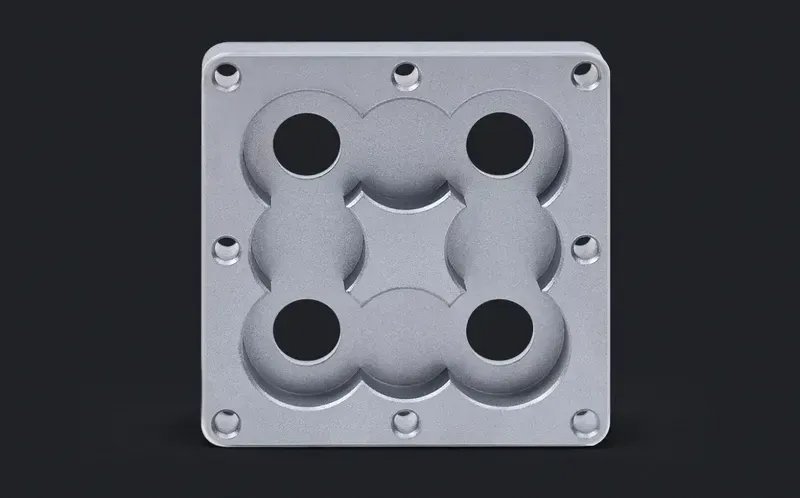
304 is the general-purpose austenitic stainless steel most machine shops cut daily, and the one buyers usually mean when a drawing says "stainless steel" without a grade. It balances corrosion resistance, formability and weldability well enough to serve indoors and in most atmospheric service, which is why it dominates enclosures, food-contact hardware, fasteners and general process equipment.
Machining 304 is straightforward but not friction-free: the austenitic structure work-hardens, so tools must keep cutting rather than rubbing, and heavy passes beat light spring passes. Sharp tooling, adequate feed and flood coolant carry the standard countermeasures; parts that need extensive welded assembly should plan for annealing or passivation after welding to restore corrosion performance at the heat-affected zones.
Specifications
| Property | Value | Condition |
|---|---|---|
| Tensile strength | 515–620 MPa | annealed |
| Yield strength (0.2% offset) | ≈205–215 MPa | annealed |
| Hardness | ≈70–85 HRB | annealed |
| Density | 8.0 g/cm³ (0.29 lb/in³) | annealed |
Values above are rendered from the collected model-evidence layer, each carrying the heat-treatment condition it was reported under; fields without collected evidence are stated as not established rather than estimated. Requirements outside the table are confirmed for the specific geometry and batch at quotation.
Applications & Selection Points
General atmospheric and indoor service
When the working environment is ambient air, fresh water or food-grade washdown, 304 is usually the economical stainless choice. Housings, brackets, conveyor components and sanitary-style fittings machined from 304 hold up where plated carbon steel would pit. If the drawing does not state a chloride environment, 304 is the default grade worth quoting first.
Where 304 is the wrong call
Chloride exposure — marine spray, de-icing salt, brine processing — is the classic boundary. Pitting corrosion in those conditions is the reason drawings move to the molybdenum-bearing grade. Similarly, parts that need high strength from heat treatment cannot get it from 304: austenitic grades strengthen by cold work only, so a strength-critical machined fitting may belong to a precipitation-hardening grade instead.
Welded assemblies and post-machining
304 welds readily with standard austenitic practice. For machined-then-welded assemblies, sensitization near the weld is managed with low-carbon practice or post-weld annealing; the low-carbon variant exists for exactly this. Passivation after machining removes free iron picked up from tooling and restores the passive surface — worth specifying on parts with cosmetic or sanitary surfaces.
Machining-behavior selection points
Expect work hardening to shape the process plan: continuous chips, positive rake tooling and non-interrupted light-finish passes. Deep bores and thin walls are where 304 punishes a sloppy sequence. Cross-drilled features and thread cutting are routine, but the shop should clear chips aggressively — re-cutting work-hardened chips is the fastest path to edge failure.
Cutting-parameter discipline behind the quoted envelope
The parameters that keep 304 cutting rather than rubbing are qualitative before they are numeric: toolpaths that maintain a constant engagement, feeds high enough to stay under the work-hardened layer, and surface speeds well below what aluminium allows. Dwell is the main enemy — a tool that rubs at the bottom of a drill cycle or hesitates on a finish pass hardens the surface it is supposed to cut, and the next pass meets skin the tool cannot enter. Rigid setups matter more than on freer materials, because chatter marks on an austenitic surface are work-hardened marks that finishing cannot remove.
Tolerance, surface finish and secondary operations
As-machined 304 carries visible tool marks; surfaces specified smoother than a milled or turned finish reaches route to polishing or lapping as secondary operations, best planned with the machining quote rather than after. Passivation after machining is the standard finishing step for corrosion performance — it removes free iron picked up from tooling without meaningfully changing dimensions, so it can sit inside a tight tolerance chain. Grinding-class tolerances are reserved for bearing seats and seal surfaces; putting them on general features buys cost without function.
Common failure and nonconformance modes
The recurring defects on machined 304 are predictable: built-up edge from insufficient lubrication or dull tooling, which tears the surface instead of shearing it; work-hardened layers from rubbing that stall subsequent passes; edge chipping from re-cutting unevacuated chips; distortion on thin walls and deep bores from clamping and heat; and rust staining after washing, which is usually free iron from carbon-steel tooling contact rather than the grade itself. Each has a process countermeasure, and each shows up at quotation as a note — parts with thin walls, deep small bores or cosmetic surfaces are where shops flag 304-specific risk.
Where 304 sits among the machinable stainless grades
Within the austenitic family, 303 is the free-machining grade — sulphur addition gives it clean chip breaking at the cost of corrosion performance — so screw-machine parts without corrosive service often route there instead. 316 machines gummier than 304 because of the molybdenum addition, so buyers who specify 316 without a chloride environment usually pay a machining premium for corrosion resistance they are not using. Positioning the grade correctly on the drawing is a cost decision as much as an engineering one.
Frequently Asked Questions
Is 304 the same as 18-8 stainless steel?
Essentially yes as a family nickname: "18-8" describes the approximate chromium and nickel balance that defines the austenitic family, and 304 is its most common member. But 18-8 is not a specification — procurement documents should name the actual grade and product form, because composition limits, product chemistry ranges and mechanical-property requirements differ between related designations within that family.
Should my part be 304 or a more corrosion-resistant grade?
Decide from the working environment, not the catalog. Ambient and washdown service usually keeps 304. Chlorides, marine spray or continuous salt exposure push the selection to the molybdenum-bearing grade, and strong acids or high-temperature reducing conditions can point elsewhere entirely. If the service environment is ambiguous, state it on the RFQ — an environment statement lets the quoting side propose the grade instead of guessing.
What should I send for a 304 machining quote?
The standard package: a STEP model plus a 2D drawing with tolerances and threads, the grade and product form called out (sheet, bar or forging matters to strength and finish), quantity and batch intent, finish and any passivation requirement, and inspection needs. If corrosion service defines the part, include the environment — it is the single input most likely to change the proposed grade.
Why does surface finish on 304 cost more to hold than on aluminium?
Three 304-specific behaviors stack up: the material work-hardens, so a rubbed or glazed surface is hardened and resists the passes meant to smooth it; continuous chips drag across the finished face unless chip evacuation is managed; and the grade galls against tooling, so built-up edge shows up as smearing rather than clean shearing. The countermeasures — sharp tooling, correct lubrication, dedicated finish passes and often a polishing operation — are real process steps, which is why a fine finish callout prices differently on 304 than on a free-cutting alloy.
My 304 part shows rust spots after machining. Is the material wrong?
Usually not. The most common cause is free iron picked up from carbon-steel tooling, handling equipment or grit blasting, which sits on the passive surface and rusts first. A passivation bath dissolves it and restores the chromium-rich layer. Genuine pitting from the base material is rare and typically traces to chloride exposure the part was not selected for. If staining recurs after passivation, the environment statement belongs back on the RFQ — it may be a grade-selection question rather than a quality defect.
Ordering & Documentation
Documents
Send a STEP or IGES model with a 2D drawing carrying tolerances, thread callouts and the finish specification. Name the grade and product form explicitly rather than writing "stainless" — several austenitic designations look interchangeable on a drawing and are not interchangeable in a supply chain.
Quotation
A quote is priced from the model and drawing, the named grade and form, quantity and batch intent, tolerance class on critical features, finish and passivation requirements, and destination country. Corrosion-service context belongs in the RFQ because it can change grade proposals, not just price.
Sample & Supply
Prototype quantities from one piece are normal for machined stainless, and prototype runs validate both the fixturing and the work-hardening behavior of the specific geometry before a production batch. First-article inspection with material certification is available on request — agree the scope at quotation.
Storage & Shipping
Machined 304 ships with the surface condition the finish callout defines — mill finish, passivated or polished. Stainless should be packed separated from carbon-steel handling contact to avoid free-iron pickup that later rusts. On receipt, store dry; the grade tolerates ordinary warehouse conditions well.