17-4 PH Stainless Steel CNC Machining
CNC machining of 17-4 PH precipitation-hardening stainless steel: collected property envelope with the H900 condition, strength-driven selection points, and quotation inputs.
Last updated: 2026-10-31
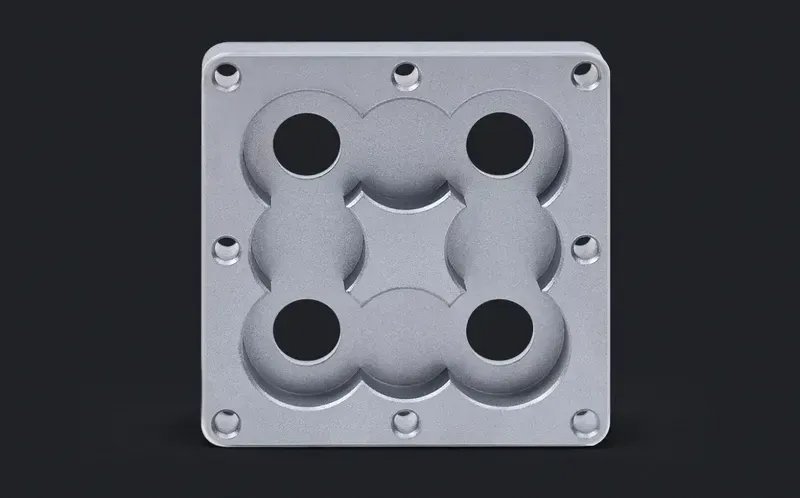
17-4 PH is the precipitation-hardening stainless steel reached for when a part needs steel-grade strength and stainless-grade corrosion resistance in the same component: aerospace actuators and fittings, valve stems and trim, pump shafts, firearm and tooling components, and surgical hardware. It ships in the solution-treated condition, machines acceptably, and then gains its characteristic strength in a low-temperature aging treatment — a sequence that shapes both procurement and machining strategy.
The H900 aging condition is the high-strength corner of the family and the one most drawings cite. Machining is usually done before aging, when the material cuts far more cooperatively; the aging distortion is small but real, which is why tight features sometimes get a finish cut after heat treatment. Planning the sequence — machine, age, finish — is the difference between a clean part and a scrapped one.
Specifications
| Property | Value | Condition |
|---|---|---|
| Tensile strength | ≈1310 MPa (~190 ksi) | H900 aged |
| Yield strength (0.2% offset) | ≈1170 MPa | H900 aged |
| Hardness | ≈40 HRC | H900 aged |
| Density | 7.75 g/cm³ | H900 aged |
| Elongation | ≈10% | Condition H900 (AMS 5604) |
Values above are rendered from the collected model-evidence layer, each carrying the heat-treatment condition it was reported under; fields without collected evidence are stated as not established rather than estimated. Requirements outside the table are confirmed for the specific geometry and batch at quotation.
Applications & Selection Points
Strength-limited stainless components
When a stainless part fails on strength rather than corrosion — loaded pins, shafts, actuator parts, high-preload fittings — this family is the standard answer, delivering strength several times that of the austenitic grades while still resisting atmospheric and mild chemical exposure. If the drawing currently says an austenitic grade and the part bends in service, this is usually the conversation to have.
The aging-condition decision
The H* conditions trade strength against toughness, and the choice is an engineering decision, not a catalog default: the highest-strength condition gives up fracture toughness and some stress-corrosion resistance. Heavy-section or impact-loaded parts often specify a slightly overaged condition instead. State the condition on the drawing — "17-4 PH" alone is an ambiguous callout that suppliers must interpret.
Corrosion envelope
Resistance is good in atmospheric and mild chemical service but below the molybdenum-bearing austenitic grades, particularly against chlorides. Marine immersion or persistent salt spray can attack it; where that service combines with high strength, the grade decision needs genuine engineering review rather than habit. For most indoor and aerospace-typical environments, it performs well.
Machining and heat-treatment sequencing
Rough machine in the solution-treated condition, leave grinding stock on precision features, age, then finish critical dimensions. Sub-zero treatments and double aging appear in aerospace practice for dimensional stability. Hardness after aging also moves the process to abrasive finishing for tight tolerance work — plan the inspection method for the aged, not the supplied, condition.
Cutting behavior before and after aging
In the solution-treated condition the material cuts like a mid-toughness alloy steel: predictable chips, conventional tooling, no work-hardening trap. After aging the same part is a hard-part-machining job — abrasive finishing, lower material-removal expectations, and CBN or grinding-class processes for precision features. This is why the sequence decision dominates cost: a drawing that leaves precision tolerances to be met after aging is pricing a different process chain than one that machines them first and accepts the small aging movement.
Tolerance strategy across the aging step
Aging distortion is small but directional and repeatable on a given geometry, which is what makes a tolerance strategy possible: critical bores and seats either carry grinding stock and are finished after aging, or are toleranced to absorb the movement. Thin-wall sections and asymmetric removals distort more than solid symmetric parts. The failure mode to design against is discovering after heat treatment that a feature can no longer be reached by a finishing process — the sequence belongs in the RFQ, not in the post-mortem.
Failure and rejection modes seen on 17-4 parts
The recurring nonconformances: inadequate hardness after aging, usually traced to a condition mismatch between drawing and supplied stock; distortion of thin or asymmetric sections through the aging step; stress-corrosion cracking in chloride service at the highest-strength condition, which is why overaged conditions exist; and free-iron rust staining from carbon-steel contact — cosmetic, but it fails incoming inspection. Each is preventable by an explicit callout (condition, sequence, environment, handling) rather than supplier interpretation.
Positioning against the austenitic grades
The selection logic between this family and 304/316 is one question: does the part fail on strength or on environment? Strength-driven parts move here and accept the narrower corrosion envelope; corrosion-driven parts stay austenitic and accept the strength ceiling. Between the conditions, the H* ladder trades toughness for strength — drawings that name the condition precisely are the ones that quote and inspect cleanly, and the comparison article below walks the 316 boundary case.
Frequently Asked Questions
What does H900 mean on a 17-4 drawing?
It names the aging treatment: aged at a nominal nine-hundred-degree-Fahrenheit class temperature, the highest-strength corner of the family. Properties after aging differ sharply between conditions, so an unqualified "17-4 PH" callout leaves the most important number on the part undefined. If your drawing lacks the condition, resolve it before quotation — it changes material sourcing, machining sequence and inspection.
Can 17-4 replace my 304 or 316 part?
Sometimes, in one direction only: where the driver is strength, yes, and the corrosion envelope still covers most atmospheric service. Where the driver is chloride corrosion resistance, no — the austenitic marine grade keeps advantages this family does not. Substituting a grade is an engineering decision about the working environment and load path, and the substitute-and-verify article below is the honest checklist.
What should I send for a 17-4 machining quote?
The standard package — model, drawing with tolerances, quantity, finish — plus the aging condition, the sequence you expect (machine-then-age is typical, but finish machining after aging must be priced as such), and any material specification or certification the part must cite. Hardness after aging is usually the acceptance criterion; say how you want it verified.
Why is my 17-4 part hard to finish after heat treatment?
Because aging is the point: the treatment that raises strength also drops machinability into hard-part territory, where ordinary carbide cutting gives way to grinding and CBN-class processes. Two routes out: finish the precision features before aging and tolerance for the small movement, or leave grinding stock on them and plan an abrasive operation after. Problems arise when the drawing assumes both — tight tolerances with no stock allowance and no post-aging operation priced. Resolving the sequence at quotation is the fix; the aged condition itself is not a defect.
How does 17-4 compare with 316 for a corrosive, loaded part?
The two grades sit at opposite corners: 316 holds its corrosion resistance in chloride service but cannot be strengthened beyond its austenitic ceiling, while 17-4 delivers steel-grade strength but gives up ground in persistent chloride exposure, worst at the highest-strength condition. A part that is both heavily loaded and chloride-wet needs a genuine engineering review — overaged 17-4 conditions, duplex grades or coatings change the answer case by case. Naming the environment and the load path on the RFQ is what turns that review into a grade decision instead of a field failure.
Ordering & Documentation
Documents
STEP model plus 2D drawing with tolerances and threads; the aging condition is a mandatory callout, as is any product standard the material must meet. Note explicitly which dimensions are finished after aging, if any — those carry a grinding or hard-turning operation that must be planned.
Quotation
Priced from model and drawing, the named condition, quantity and batch intent, the machining/heat-treatment sequence, finish, and destination country. Certification requirements (mill certs, hardness verification) are quotation line items — declare them rather than assuming they ride along.
Sample & Supply
A prototype run in the delivered condition validates fixturing and the post-aging distortion on your specific geometry — the first article should be measured after aging, not before. Small batches through production are normal; agree the inspection stage and hardness method at quotation.
Storage & Shipping
Parts ship in the aged condition with the finish called out. Keep handling free of carbon-steel contact to avoid free-iron rust stains on a stainless part, and store dry. Because aging is done, the parts are dimensionally stable in ordinary transport and warehouse conditions.